Your shoulders are tense. Your jaw is clenched. Your breath is shallow. You're holding stress in your body, and you might not even realize it.
Body scan meditation is a powerful mindfulness practice that brings awareness to physical sensations throughout your body. It's one of the most effective techniques for releasing tension, reducing stress, and cultivating a deeper connection between mind and body.
"The body keeps the score." — Bessel van der Kolk
This article is part of our complete guide
Read the Mindfulness GuideWhat Is Body Scan Meditation?
Body scan meditation is a practice of systematically moving your attention through different parts of your body, from your toes to the crown of your head (or vice versa), simply noticing sensations without trying to change them.
It's a core practice in Mindfulness-Based Stress Reduction (MBSR), developed by Jon Kabat-Zinn at the University of Massachusetts Medical School. Decades of research have validated its effectiveness for stress reduction, pain management, and overall well-being.
What Makes It Different
- Not progressive muscle relaxation: You're not tensing and releasing muscles—you're simply observing
- Not visualization: You're not imagining anything—you're feeling what's actually there
- Not fixing: You're not trying to change sensations—you're cultivating awareness
The paradox: By not trying to relax, you often achieve deeper relaxation than if you tried to force it.
The Science-Backed Benefits
Reduces Physical Tension
We hold stress in our bodies without realizing it. Body scan meditation brings awareness to areas of tension, and awareness itself often leads to natural release. Studies show regular practice significantly reduces chronic muscle tension.
Improves Sleep Quality
Body scan meditation activates the parasympathetic nervous system—your body's "rest and digest" mode. Research shows it's highly effective for insomnia, helping practitioners fall asleep faster and sleep more deeply.
Manages Chronic Pain
Jon Kabat-Zinn originally developed this technique for chronic pain patients. Studies demonstrate that body scan meditation changes the relationship with pain—even when pain sensations remain, the suffering decreases.
Decreases Anxiety and Stress
By anchoring attention in physical sensations, body scan meditation interrupts anxious thought patterns. Multiple studies show significant reductions in anxiety and stress hormones.
Enhances Mind-Body Connection
Many of us live almost entirely in our heads, disconnected from bodily signals. Body scan meditation rebuilds this crucial connection, improving emotional regulation and self-awareness.
Increases Present-Moment Awareness
Your body exists only in the present moment. By focusing on bodily sensations, you naturally become more present, less caught up in regrets about the past or worries about the future.
How to Practice Body Scan Meditation: Step-by-Step
Preparation
Find a quiet space: Choose somewhere you won't be interrupted for 15-30 minutes.
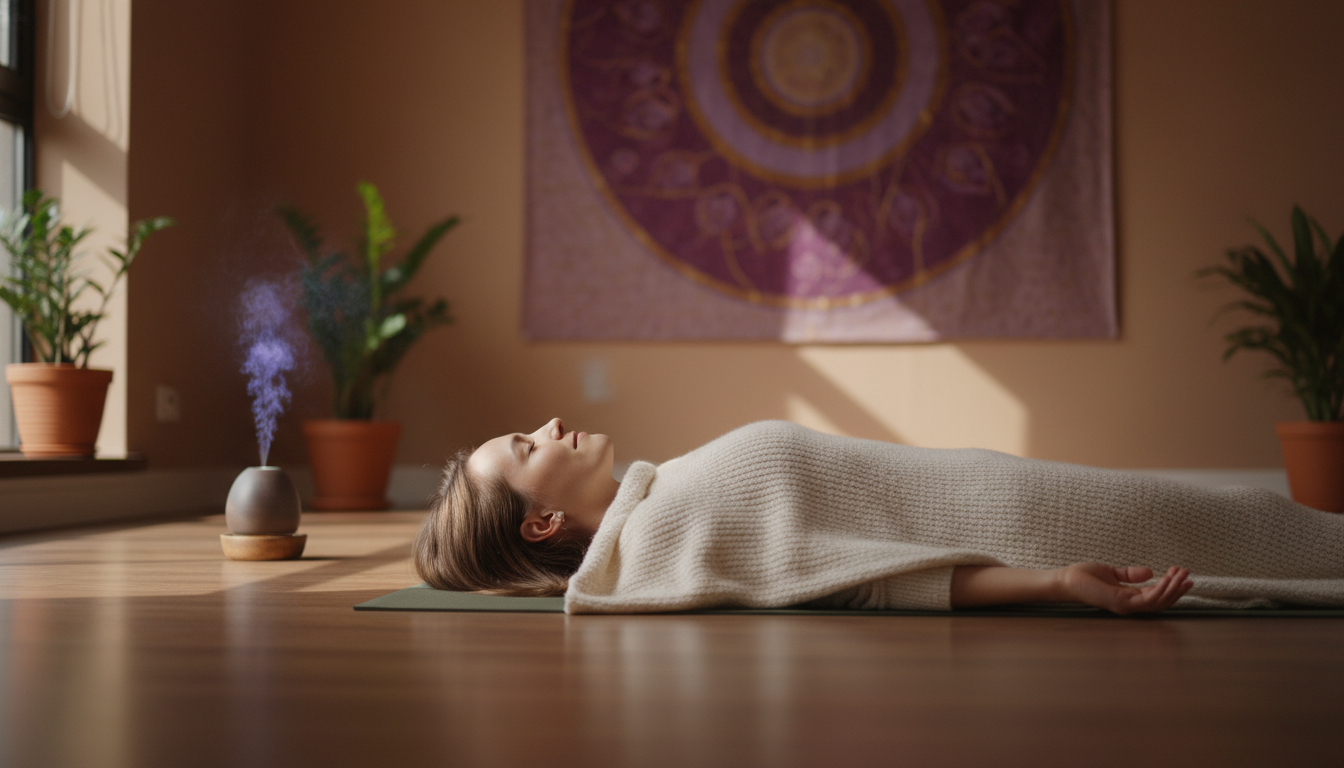
Get comfortable: Most people lie down on their back (on a bed, yoga mat, or carpet). You can also sit in a comfortable chair if lying down makes you too sleepy.
Set a timer: Start with 10-15 minutes and gradually increase to 30-45 minutes as you become more comfortable.
Adjust your body: If lying down, let your legs fall slightly apart, arms at your sides with palms facing up. Place a pillow under your knees if that's more comfortable.
The Practice
Step 1: Settle In (2 minutes)
Close your eyes. Take three deep breaths. Notice the weight of your body against the surface beneath you. Let yourself arrive fully in this moment.
Step 2: Begin with the Breath (2 minutes)
Bring your attention to your breathing. Don't try to change it—just notice it. The rise and fall of your chest. The sensation of air moving in and out. This anchors your awareness in the present.
Step 3: Move to the Feet (2-3 minutes)
Shift your attention to your left foot. Notice any sensations:
- Temperature (warm, cool, neutral?)
- Pressure (where the foot contacts the surface)
- Tingling, pulsing, or numbness
- Tension or relaxation
If you don't feel much, that's okay. The absence of sensation is itself a sensation. Just notice what's there—or what isn't.
Step 4: Progress Through the Body
Systematically move your attention up through your body:
- Left foot, then right foot
- Left ankle and lower leg, then right
- Left knee and thigh, then right
- Hips and pelvis
- Lower back and abdomen
- Upper back and chest
- Left hand and arm, then right
- Shoulders and neck
- Face (jaw, mouth, nose, eyes, forehead)
- Top of the head
Spend 30-60 seconds with each area. There's no rush.
Step 5: Breathe Through Each Area
As you focus on each body part, you can imagine breathing into it. On the inhale, imagine breath flowing to that area. On the exhale, imagine releasing any tension.
This isn't literal—you're not actually breathing into your foot. It's a mental technique to deepen awareness and facilitate release.
Step 6: Notice Without Judging
You'll encounter various sensations: pleasant, unpleasant, neutral. The practice is to notice them without labeling them as "good" or "bad," without trying to make pleasant sensations last or unpleasant ones go away.
Simply observe. "Ah, there's tension in my shoulders. Interesting."
Step 7: When Your Mind Wanders
Your mind will wander. You'll start thinking about your to-do list, a conversation, what's for dinner. This is completely normal.
When you notice you've drifted away, gently—without frustration or judgment—return your attention to the body part you were scanning. Each return is a success, not a failure.
Step 8: Complete with Whole-Body Awareness
After scanning through every part, expand your awareness to include your entire body at once. Feel yourself as a complete, unified whole. Rest in this wholeness for a few minutes.
Step 9: Transition Back
When ready to end, gradually bring awareness back to the room. Wiggle your fingers and toes. Stretch gently. Open your eyes slowly. Take your time standing up—don't rush this transition.
Different Approaches to Body Scan
Short Body Scan (5-10 minutes)
Move through body regions more quickly: feet and legs, torso, arms, head. Spend just 30-60 seconds per region. Perfect for daily practice or when time is limited.
Detailed Body Scan (30-45 minutes)
Take your time with each small area—each toe, each finger. This deeper practice is excellent for releasing chronic tension and developing refined body awareness.
Standing or Sitting Body Scan
If lying down isn't practical or makes you too sleepy, do a body scan while sitting or even standing. The principle remains the same: systematic attention through the body.
Body Scan for Sleep
Practice body scan in bed as you're falling asleep. Move very slowly through each area. If you fall asleep before completing it, that's perfect—you've achieved the goal.
Common Challenges and Solutions
Challenge: "I fall asleep every time"
Solution: If this happens during the day and you don't want to sleep, try sitting up instead of lying down, or practice with eyes slightly open. However, if you're practicing at bedtime, falling asleep is actually ideal.
Challenge: "I feel nothing in some body parts"
Solution: Numbness or absence of sensation is itself something to notice. Don't force sensations that aren't there. Simply acknowledge the lack of sensation and move on.
Challenge: "I encounter pain or discomfort"
Solution: Don't avoid areas of discomfort. Breathe into them gently. Notice the sensations with curiosity rather than resistance. Often, bringing kind awareness to pain reduces its intensity. However, if pain is severe, adjust your position or consult a healthcare provider.
Challenge: "My mind won't stop wandering"
Solution: Mind-wandering isn't a problem—it's the nature of minds. The practice is noticing you've wandered and returning. Some days your mind will be calmer, others more restless. Both are fine.
Challenge: "I get anxious or emotional"
Solution: Sometimes body scan releases stored emotions. This is natural. If it becomes overwhelming, open your eyes, return to the breath, or pause the practice. Consider working with a therapist if strong emotions consistently arise.
Challenge: "I feel restless and want to move"
Solution: Notice the restlessness itself as a sensation. Where do you feel it? Can you breathe into it? If truly uncomfortable, adjust your position mindfully, then continue. Or try walking meditation instead.
Tips for Building a Consistent Practice
- Same time daily: Practice at the same time each day to build a habit. Morning or bedtime work well for most people
- Use guided recordings: Especially helpful for beginners. Many apps and YouTube videos offer guided body scans
- Start small: Even 5 minutes daily is valuable. Better to do a short practice consistently than a long one sporadically
- Create a ritual: Dim the lights, light a candle, use the same blanket. Small rituals signal to your brain that it's time to practice
- Track your practice: Note how you feel before and after. This helps you see progress and stay motivated
- Be patient: Benefits accumulate over time. Don't expect instant transformation
Body Scan for Specific Situations
For Insomnia
Practice body scan in bed. Move extremely slowly through each area. The goal isn't to finish—it's to fall asleep. Let the practice be a gentle transition into rest.
For Chronic Pain
Bring gentle, curious attention to areas of pain without trying to make the pain go away. Notice the exact qualities: sharp or dull? Constant or pulsing? Notice how sensations change moment to moment.
For Anxiety
When anxious, do a quick body scan to anchor yourself. Notice where you're holding tension (jaw, shoulders, stomach are common). Breathe into those areas. Physical grounding reduces mental anxiety.
Before Important Events
A 5-minute body scan before a presentation, interview, or difficult conversation grounds you in the present moment and releases performance anxiety.
Combining Body Scan with Other Practices
Body Scan + Breath Meditation
Start with 5 minutes of breath meditation to settle the mind, then move into body scan. The settled mind makes body awareness easier.
Body Scan + Yoga
Practice body scan after yoga. Your body awareness is already heightened, making sensations easier to notice.
Body Scan + Journaling
After body scan, spend a few minutes journaling about what you noticed. This deepens insight and tracks patterns over time.
Body Scan + Progressive Muscle Relaxation
Alternate between these practices. On some days, actively tense and release muscles (PMR). On other days, simply observe (body scan).
The Body Scan and Emotional Awareness
Emotions aren't just mental—they're embodied. Anxiety creates tightness in the chest. Sadness creates heaviness. Anger creates heat. Joy creates lightness and expansion.
Body scan meditation helps you recognize the physical signatures of emotions. This awareness is powerful: When you notice tightness in your chest, you can recognize, "Ah, I'm feeling anxious," even before your mind has labeled the emotion.
This early recognition allows you to respond to emotions skillfully rather than being overwhelmed by them.
Body Scan Meditation and Soul Compass
Body scan meditation and Soul Compass are beautifully complementary practices. Body scan develops awareness of your physical and emotional state. Soul Compass helps you reflect on your values, patterns, and growth.
Try this combination: Practice body scan meditation in the morning to start your day grounded and present. Use Soul Compass in the evening to reflect on your day with intention and insight. Together, they create a complete practice of embodied awareness and reflective wisdom.
Your First Body Scan Practice
Ready to experience it? Here's a simple 10-minute practice to start:
- Lie down comfortably in a quiet space
- Close your eyes and take three deep breaths
- Notice the weight of your body against the surface beneath you
- Bring attention to your left foot—just notice any sensations there
- After about a minute, move to your right foot
- Progress up through legs, torso, arms, and head—spending about a minute with each region
- When your mind wanders, gently return to the body part you're scanning
- Finish with a minute of whole-body awareness
- Slowly transition back, wiggle fingers and toes, open eyes
That's it. You've just practiced body scan meditation.
Your body holds wisdom. It knows when you're stressed before your mind does. It knows what you need. Body scan meditation is simply the practice of listening.
Deepen Your Self-Awareness Practice
Combine body scan meditation with daily reflection on Soul Compass
Begin Your JourneyWritten by
Soul CompassEntrepreneur with 20+ years in tech. Exploring the intersection of logic and intuition.